DAJK Group
  • About
  • Project Funding
  • Financial Services & Asset Management
  • Net Lease Investment
  • Business Finance & Development
  • Consultant & Concierge Services
  • Investment & Business Resources
  • GEP Blog
  • GEP Blog2
  • Business Principles
  • Contact

You Will Get Rejected — How You Handle It Will Make You Successful​

Wealth Management - 1 OF 2

6/11/2023

0 Comments


​How To Grow Your Wealth From 100 Million To 1 Billion
Picture
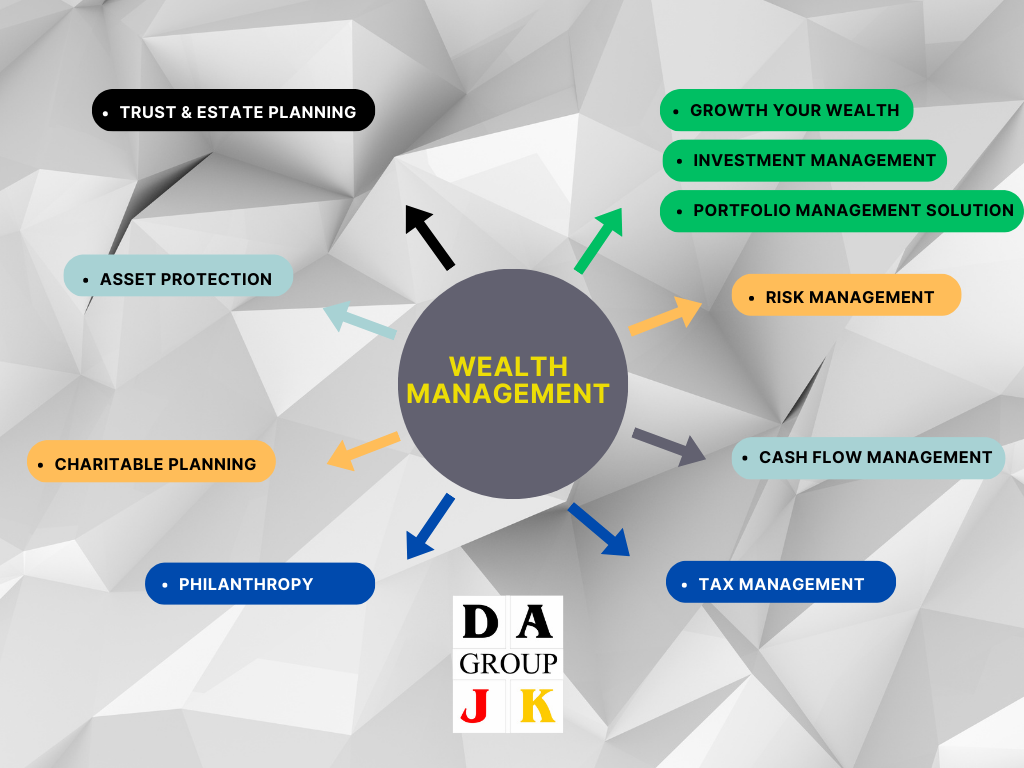
Highlights:
​

Part 1:
  1. Growth Your Wealth, Investment Management, Portfolio Management Solution
  2. Risk Management
Part 2:
  1. Cash Flow Management
  2. Tax Management
  3. Trust & Estate Planning
  4. Asset Protection
  5. Charitable Planning & Philanthropy

​Growth Your Wealth

There are many ways to grow your wealth. Some common methods include investing in stocks, bonds, mutual funds, and commercial real estate. You can also grow your wealth by saving money and paying down debt. By taking steps to grow your wealth, you can improve your financial security and achieve your financial goals.
 
Here are some tips on how to grow your wealth from 100 million to 1 billion:
  1. Invest in assets that have the potential to grow significantly in value. This could include stocks, commercial real estate, or businesses.
  2. Take on calculated risk. If you want to grow your wealth significantly, you'll need to be willing to take on some risk. However, it's important to balance risk with your investment objectives and risk tolerance.
  3. Be patient. It takes time to grow wealth. Don't expect 100 million into 1 billion overnight.
  4. Contact us.  We can help you develop an investment strategy that is tailored to your individual needs and goals.
Here are some specific examples of investments that have the potential to grow significantly in value:
  • Stocks: Stocks are shares of ownership in a company. When a company does well, the value of its stock typically goes up.
  • Commercial Real estate: Commercial Real estate Net Lease can be a great way to grow wealth over the long term. The value of real estate tends to go up over time, and it can also generate income through rent payments.
  • Businesses: If you're willing to take on more risk, you could consider investing in businesses such as Apple, Microsoft, Alphabet, Amazon, JPMorgan Chase, Alibaba, Tencent, and Walmart…etc. This could involve buying a small business outright or investing in a private equity fund.  These companies are all large, well-established businesses with strong track records of profitability. They are also leaders in their respective industries, which gives them a competitive advantage. Additionally, they are all global businesses, which means that they are not as susceptible to economic downturns in any one region.
​Here are some additional factors to consider when choosing global businesses for investment:
  • Industry: The industry in which a company operates is important to consider. Some industries, such as technology and healthcare, are more cyclical than others. This means that they are more likely to experience periods of high growth followed by periods of low growth.
  • Management: The quality of management is another important factor to consider. Good management can help a company to weather difficult times and achieve long-term success.
  • Financial strength: A company's financial strength is important to consider because it can affect its ability to weather economic downturns and make strategic investments.
  • Valuation: The valuation of a company is important to consider because it can affect the potential return on investment. A company that is undervalued may offer a good opportunity for long-term growth.
 
  • Tier-1 Commercial Bank Instruments:  Tier-1 commercial banks issue a variety of bank instruments for private placement programs, including:
    • Medium-term notes (MTNs): MTNs are debt securities that have a maturity of at least one year and are typically issued by corporations or governments. MTNs can be used to raise capital for a variety of purposes, such as expansion, acquisitions, or refinancing debt.
    • Bank guarantees (BGs): BGs are a type of surety bond that is issued by a bank to guarantee the performance of a contract. BGs are often used in international trade to protect buyers from default by sellers.
    • Standby letters of credit (SBLCs): SBLCs are a type of letter of credit that is issued by a bank to guarantee payment of a debt. SBLCs are often used in international trade to protect sellers from default by buyers.
  • These bank instruments can be used to create a variety of private placement programs, such as:
    • Debt funds: Debt funds invest in debt securities, such as MTNs and BGs. Debt funds can provide investors with a high level of income, but they also carry a high level of risk.
    • Mezzanine funds: Mezzanine funds invest in mezzanine debt, which is a type of debt that is subordinate to senior debt. Mezzanine debt typically has a higher yield than senior debt, but it also carries a higher level of risk.
    • Real estate funds: Real estate funds invest in real estate, such as commercial properties and residential properties. Real estate funds can provide investors with the potential for high returns, but they also carry a high level of risk.
  • It is important to note that private placement programs are not regulated by the Securities and Exchange Commission (SEC). This means that investors should do their own due diligence before investing in any private placement program. They should carefully review the terms of the offering and make sure that they understand the risks involved.
  • Here are some of the risks associated with investing in private placement programs:
    • Illiquidity: Private placement programs are often illiquid, meaning that it can be difficult to sell the investment if you need to.
    • Lack of transparency: Private placement programs are often not as transparent as public offerings, meaning that it can be difficult to get information about the investment.
    • Higher risk: Private placement programs are often higher risk than public offerings. This is because they are not subject to the same level of regulation as public offerings.
  • Despite the risks, private placement programs can be a good way for investors to access a wider range of investment options. However, it is important to do your research and understand the risks before investing.
It's important to note that there is no guarantee that any investment will be appreciated. However, if you're willing to take on some risk and be patient, you have a good chance of growing your wealth from 100 million to 1 billion.
​
Here are some additional tips that may help you grow your wealth:

  • Live below your means. This will free up more money to invest.
  • Pay off debt. Debt can reduce your net worth and make it more difficult to save and invest.
  • Max out your retirement savings. This will help you save for the future and grow your wealth tax deferred.
  • Invest in the long term. The stock market is volatile in the short term, but it has historically trended upwards over the long term.
  • Rebalance your portfolio regularly. This will help you stay on track with your investment goals and reduce your risk.
  • Research, learn, and consult with us. We can help you develop an investment strategy that is tailored to your individual needs and goals.
Picture

​Investment Management

​Investment management is the process of overseeing and managing an investment portfolio. This includes tasks such as selecting investments, rebalancing the portfolio, and monitoring performance. Investment managers can help you achieve your financial goals by investing your money in a way that is aligned with your risk tolerance and investment objectives.

​Portfolio Management Solution

A portfolio management solution is a software program that helps you track, manage, and analyze your investment portfolio. These solutions can help you to:
  • Track your investments.
  • Set investment goals.
  • Monitor your performance.
  • Make informed investment decisions.
  • Automate your investment process.

​Risk Management

Risk management is the process of identifying, assessing, and mitigating risks. This is an important part of any investment strategy. By understanding the risks involved in your investments, you can make informed decisions about how to allocate your assets.
 
Here are several specific steps involved in risk management:
  1. Identify the risks. The first step in risk management is to identify the potential risks that could impact on your business. This could include risks such as:
    • Financial risks, such as a loss of revenue or an increase in costs
    • Operational risks, such as a data breach or a natural disaster
    • Compliance risks, such as violating regulations.
    • Reputational risks, such as a product recall or a scandal
  2. Assess the risks. Once you have identified the potential risks, you need to assess their likelihood and impact. This will help you to prioritize the risks and focus your efforts on the most important ones.
  3. Develop risk mitigation strategies. Once you have assessed the risks, you need to develop strategies to mitigate them. This could involve:
    • Avoiding the risk altogether
    • Reducing the likelihood of the risk occurring
    • Reducing the impact of the risk if it does occur.
  4. Implement risk mitigation strategies. Once you have developed risk mitigation strategies, you need to implement them. This could involve:
    • Putting in place new policies and procedures
    • Training employees on risk management
    • Buying insurance
  5. Monitor the risks. Once you have implemented the risk mitigation strategies, you need to monitor the risks to make sure they are still effective. This could involve:
    • Reviewing the risk register on a regular basis
    • Conducting risk assessments on a regular basis
    • Responding to new risks as they emerge
Risk management is an ongoing process. It is important to regularly review your risk management plan and make changes as needed.

Here are some additional tips for effective risk management:
  • Get buy-in from senior management. Risk management is everyone's responsibility, but it is important to have the support of senior management. This will help to ensure that risk management is taken seriously and that resources are allocated to it.
  • Create a risk culture. A risk culture is one in which employees are encouraged to identify and report risks. This can be done by providing training on risk management, creating a system for reporting risks, and rewarding employees for reporting risks.
  • Use technology. There are several software tools that can help with risk management. These tools can help you to identify risks, assess risks, and develop risk mitigation strategies.
By following these steps, you can develop an effective risk management plan that will help to protect your business from potential risks.

Part 2 of 2

IMPORTANT NOTICE: This is unofficial information and for information purposes only. This is not intended to be and must not be construed to be in any form or manner a solicitation of investment funds or a security offering. Before undertaking any action, be sure to discuss your options with a qualified advisor.
​
Contact Us
0 Comments


Leave a Reply.

    Author

    DAJK GROUP is the place where investors, business owners and entrepreneurs can research and find useful information, insight, resources, advice, guidance and inspiration for acquiring funds for their project, acquisition for their net lease commercial real estate, increasing their assets and running their profitable business.

    Archives

    July 2023
    June 2023
    May 2023
    August 2019
    March 2019
    December 2018
    October 2018
    September 2018
    August 2018
    July 2018
    June 2018
    May 2018
    April 2018
    March 2018
    January 2018
    December 2017
    November 2017
    October 2017
    September 2017
    July 2017
    June 2017
    May 2017
    April 2017
    March 2017
    January 2017
    December 2016
    November 2016
    October 2016
    September 2016
    August 2016
    July 2016
    June 2016
    May 2016
    April 2016
    February 2016
    January 2016
    December 2015
    October 2015
    September 2015
    August 2015
    July 2015
    June 2015

    Categories

    All

    Contact Us

Services

Project Funding
Business Finance & Development

Net Lease CRE Investment
Concierge Services
​Finance & Asset Management


Company

About
Business Principles
Blog GEP
Blog

Support

Contact
Privacy Policy
Disclaimer
3592 Rosemead Blvd 526  
​Rosemead - California 91770

Los Angeles - USA
T:  +562.301.7231
© COPYRIGHT 2015. ALL RIGHTS RESERVED.
  • About
  • Project Funding
  • Financial Services & Asset Management
  • Net Lease Investment
  • Business Finance & Development
  • Consultant & Concierge Services
  • Investment & Business Resources
  • GEP Blog
  • GEP Blog2
  • Business Principles
  • Contact